Lease options are one of the more misunderstood tools in UK property investing.
To some investors, they sound like a shortcut to control property without needing large amounts of capital.
To some vendors, they sound risky, complicated or “too creative”.
The reality is more nuanced.
Used properly, lease options can solve genuine problems for both buyer and seller. Used badly, they can create confusion, unrealistic expectations and legal headaches.
The key is understanding when they actually make sense.
What Is a Lease Option?
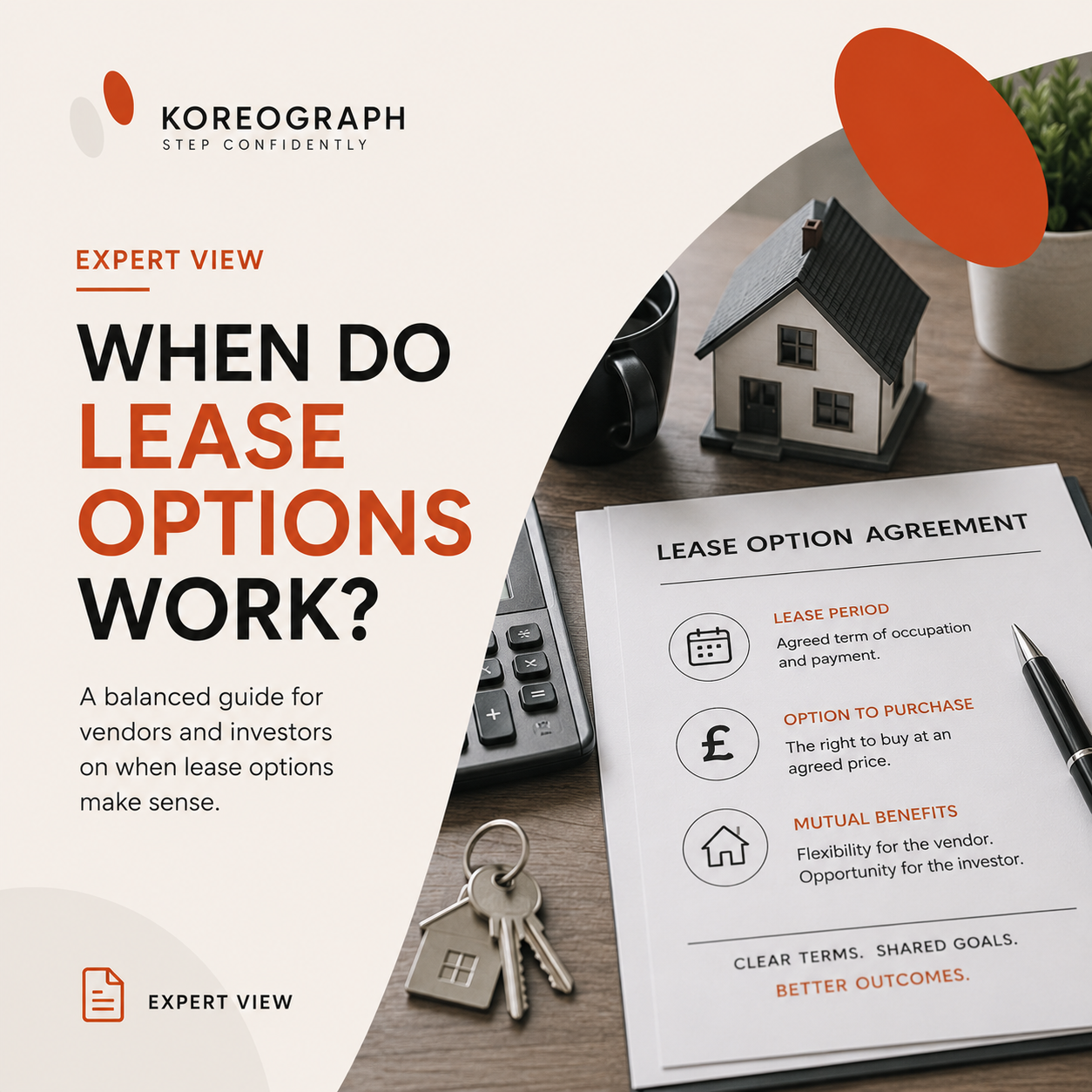
At its simplest, a lease option is an agreement where:
- The investor gains control of a property for a defined period
- The vendor retains ownership during that period
- The investor usually pays monthly amounts to the vendor
- The investor has the option — but not always the obligation — to buy the property later at agreed terms
Think of it as separating:
- control of the property
from - immediate ownership of the property
This distinction is important.
In many cases, the investor operates the property, improves it or generates income from it before eventually purchasing.
Why Would a Vendor Agree to a Lease Option?
This is the question many people ask first.
Why would a vendor not simply sell normally?
The answer is that lease options are usually most useful when a standard sale is difficult, undesirable or slow.
Lease options are often considered when a vendor:
- Struggles to sell conventionally
- Needs monthly income
- Has little equity
- Faces mortgage pressure
- Owns a problematic property
- Wants a delayed sale
- Wants a fixed future price
- Has tenant complications
- Cannot achieve desired value today
- Wants flexibility
In other words:
Lease options tend to solve timing problems more than price problems.
Situations Where Lease Options Can Work Well
1. Low Equity or Negative Equity
A vendor may owe almost as much as the property is worth.
Selling conventionally could require bringing cash to completion.
A lease option may allow:
- Mortgage payments to continue being covered
- Time for values to improve
- A delayed future sale
- Reduced financial pressure
For the investor, this can create control of a property with lower upfront capital requirements.
2. Problem Properties
Some properties are difficult to finance or sell immediately:
- Short leases
- Poor condition
- Non-standard construction
- Structural issues
- Complex title situations
- Properties with sitting tenants
A lease option can create breathing room for:
- Refurbishment
- Repositioning
- Planning improvements
- Lease extensions
- Rental stabilisation
The investor gains time to improve the asset before refinancing or purchasing.
3. Vendors Prioritising Income
Not every seller needs a lump sum immediately.
Some vendors care more about:
- Reliable monthly income
- Mortgage coverage
- Reduced management stress
- Predictable future exit
For example:
An exhausted landlord may prefer stable monthly payments and eventual disposal rather than handling voids, repairs and tenant management themselves.
4. Delayed Development or Planning Potential
Some opportunities require time before full value can be unlocked.
Examples:
- Title splits
- Planning gain
- Commercial conversions
- HMOs
- Flat conversions
- Permitted development strategies
An investor may secure control today while exploring feasibility before committing to a full purchase later.
This can substantially reduce downside risk.
How Investors Typically Benefit
The attraction for investors is usually one or more of the following:
Reduced Upfront Capital
Lease options can sometimes reduce:
- Deposit requirements
- Stamp duty timing
- Immediate financing pressure
Although this is often overstated online, there are genuine situations where capital efficiency improves.
Control Without Immediate Purchase
The investor may gain:
- Operational control
- Rental income
- Improvement rights
- Future purchase rights
This creates flexibility.
Time to Improve the Deal
A lease option may allow the investor to:
- Refurbish
- Increase rental income
- Improve tenant quality
- Secure planning
- Extend leases
- Resolve legal issues
before fully purchasing.
The Risks Investors Sometimes Ignore
Lease options are not “free houses”.
And they are not risk-free.
Experienced investors understand there are still major responsibilities involved.
You May Still Carry Property Risk
Even without legal ownership, the investor may still become responsible for:
- Repairs
- Insurance obligations
- Tenant management
- Compliance
- Void periods
- Maintenance costs
Control often creates operational liability.
Mortgage Terms Matter
Some vendor mortgages prohibit certain arrangements.
Poorly structured agreements can create lender problems.
Professional legal advice is essential.
Exit Strategy Is Critical
Many lease options fail because the investor never properly planned:
- refinance routes
- future purchase funding
- resale strategy
- planning viability
- realistic cash flow
Hope is not an exit strategy.
Vendors Also Carry Risks
The vendor must trust that:
- The investor maintains the property properly
- Payments continue reliably
- Legal agreements are enforceable
- The investor behaves professionally
Poor operators have damaged the reputation of lease options in parts of the market.
That is why transparency matters enormously.
Good Lease Options Usually Share Similar Characteristics
The strongest agreements tend to involve:
- Clear legal documentation
- Honest expectations
- Genuine win-win structure
- Realistic timelines
- Defined responsibilities
- Clear exit routes
- Proper legal advice
- Conservative assumptions
The weakest deals usually rely on:
- vague promises
- unrealistic appreciation assumptions
- aggressive sales tactics
- overoptimistic refinancing expectations
When Lease Options Probably Do NOT Make Sense
Lease options are not ideal for every situation.
They may be unsuitable when:
- The vendor can easily sell conventionally
- The investor lacks operational experience
- Financing assumptions are weak
- Margins are too thin
- The agreement relies entirely on future appreciation
- Legal complexity outweighs opportunity
- Relationships between parties lack trust
Sometimes a standard purchase is simpler, safer and more appropriate.
The Vendor Perspective Matters More Than Many Investors Realise
One of the biggest mistakes inexperienced investors make is focusing only on:
“How do I acquire property with little money?”
Experienced investors instead ask:
“What problem am I solving for the vendor?”
That distinction matters enormously.
Good lease options solve real vendor problems.
Bad lease options simply attempt to transfer risk unfairly.
Final Thoughts
Lease options are neither magic nor inherently dangerous.
They are simply one tool among many in property investing.
When used carefully, they can:
- Create flexibility
- Reduce immediate capital strain
- Solve difficult vendor situations
- Unlock value over time
- Improve deal structure for both parties
But they require:
- professionalism
- legal clarity
- realistic underwriting
- strong communication
- conservative assumptions
The best investors do not chase complexity for its own sake.
They use structures that fit the situation.
And sometimes, a carefully structured lease option can do exactly that.