For many property investors, planning permission is one of the biggest barriers to unlocking value.
It introduces:
- uncertainty,
- delay,
- professional costs,
- and execution risk.
That is why permitted development rights have become such a major part of modern UK property investing.
In the right circumstances, they can allow investors to change the use of buildings without going through a full planning application process.
And in some parts of the market, that can create surprisingly low cost-per-square-foot opportunities.
What Is Permitted Development?
Permitted development rights (PDR) are planning rights granted nationally by government.
In simple terms, they allow certain types of development or change of use without requiring full planning permission.
That does not mean:
- “no rules”
or - “automatic approval”.
Many projects still require:
- prior approval,
- building regulations,
- structural compliance,
- and planning checks.
But the process is often faster and more predictable than full planning.
Why Investors Care So Much About PDR
Traditional residential development land can be expensive.
Commercial buildings, by contrast, can sometimes be purchased at much lower values per square foot.
Examples include:
- vacant offices,
- tired retail units,
- former banks,
- gyms,
- clinics,
- storage buildings,
- and upper-floor commercial space.
The opportunity comes from changing:
- lower-value commercial space
into - higher-value residential space.
That spread is where many investors see potential.
The Rise of Class MA
One of the most important recent changes has been Class MA permitted development rights.
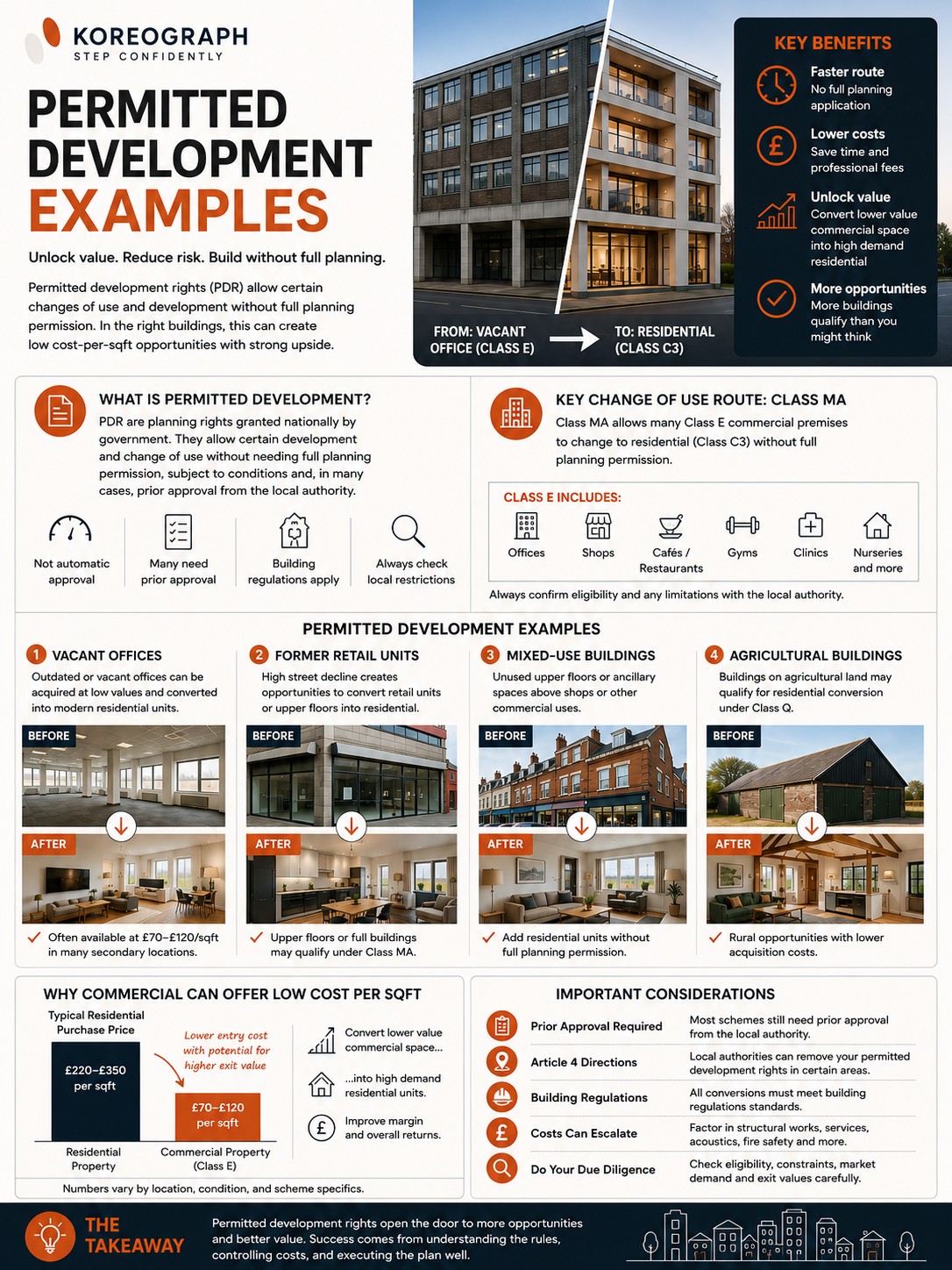
Class MA allows many Class E commercial properties to be converted into residential use without full planning permission.
Class E includes uses such as:
- offices,
- shops,
- cafés,
- gyms,
- nurseries,
- clinics,
- and some other commercial premises.
This significantly widened the range of potential conversion opportunities.
Example 1: Vacant High Street Offices
Many secondary town centres contain:
- partially vacant office space,
- upper floors with little demand,
- or outdated commercial layouts.
An investor may acquire:
- a struggling office building at £70–£120/sqft
and convert it into residential units worth:
- substantially more per sqft once complete.
The numbers depend heavily on:
- location,
- specification,
- build costs,
- and unit sizes.
But the planning simplification can materially improve viability.
Example 2: Former Retail Units
Retail decline has created opportunities in:
- empty shops,
- failed chain stores,
- and oversized retail footprints.
Under Class MA, some of these buildings may qualify for residential conversion.
In some towns, investors have:
- retained active ground-floor frontage,
while - converting upper floors into flats.
Others pursue full residential conversion where commercial demand has weakened significantly.
Example 3: Mixed-Use Buildings
Some mixed-use properties contain:
- underutilised storage space,
- vacant upper floors,
- or unused offices above shops.
These spaces can sometimes be repositioned into:
- studio flats,
- HMOs,
- or small apartments.
Often the value is hidden simply because previous owners never explored the planning potential properly.
Example 4: Agricultural Buildings
Separate permitted development routes — such as Class Q — allow some agricultural buildings to be converted into residential use.
Barn conversions remain popular because:
- acquisition costs can be lower,
- existing structures already exist,
- and rural housing demand can be strong.
But these projects often involve:
- significant structural work,
- infrastructure upgrades,
- drainage challenges,
- and careful planning interpretation.
Cheap acquisition does not always mean cheap delivery.
Why Low Cost Per Square Foot Matters
Experienced investors often focus less on purchase price and more on:
- total cost per usable square foot.
Commercial property can sometimes look expensive overall but still represent strong value internally.
For example:
A tired office block purchased at:
- £90/sqft
may still compare favourably to:
- residential stock trading at £220–£350/sqft locally.
If conversion costs remain controlled, that spread can create opportunity.
But Cheap Space Alone Is Not Enough
This is where inexperienced investors sometimes go wrong.
Low purchase price does not automatically mean:
- profitable development.
Many commercial conversions fail because investors underestimate:
- build costs,
- fire regulations,
- structural upgrades,
- acoustic requirements,
- finance costs,
- utilities,
- and exit values.
Commercial buildings were not designed originally for residential living.
That creates complexity.
Prior Approval Still Matters
Most permitted development schemes still require prior approval from the local authority.
Councils may assess issues such as:
- natural light,
- flooding,
- transport impacts,
- contamination,
- noise,
- and design constraints.
This is not a “skip planning entirely” strategy.
It is simply a narrower and often faster approval route.
Article 4 Directions Can Stop Projects
One of the most important risks is Article 4 Directions.
Local authorities can remove permitted development rights in specific areas.
This is particularly common in:
- city centres,
- core employment areas,
- and parts of London.
Many investors spend money on feasibility work before discovering Class MA rights have been removed locally.
Due diligence matters enormously.
The Best Opportunities Are Often Operational
The strongest permitted development projects are rarely just:
“buy building, convert building”.
Good operators improve outcomes through:
- layout optimisation,
- smarter unit mix,
- better finance structuring,
- efficient construction,
- and strong acquisition discipline.
The planning route alone is not the edge.
Execution still matters.
Final Thoughts
Permitted development rights have opened significant opportunities across UK property investing.
Especially in:
- underused commercial buildings,
- secondary retail space,
- vacant offices,
- and mixed-use property.
For the right investor, they can create:
- lower acquisition costs,
- faster planning routes,
- and attractive value-per-square-foot opportunities.
But successful projects still require:
- detailed due diligence,
- careful cost control,
- planning awareness,
- and realistic exit assumptions.
The buildings may sometimes be cheap.
Turning them into profitable residential assets rarely is.